
Problem
People with visual impairments rely heavily on others for day-to-day tasks: getting around, identifying objects and money, and reading text. Existing assistive tools usually need high-end hardware and an internet connection, which makes them awkward to depend on.
What I built
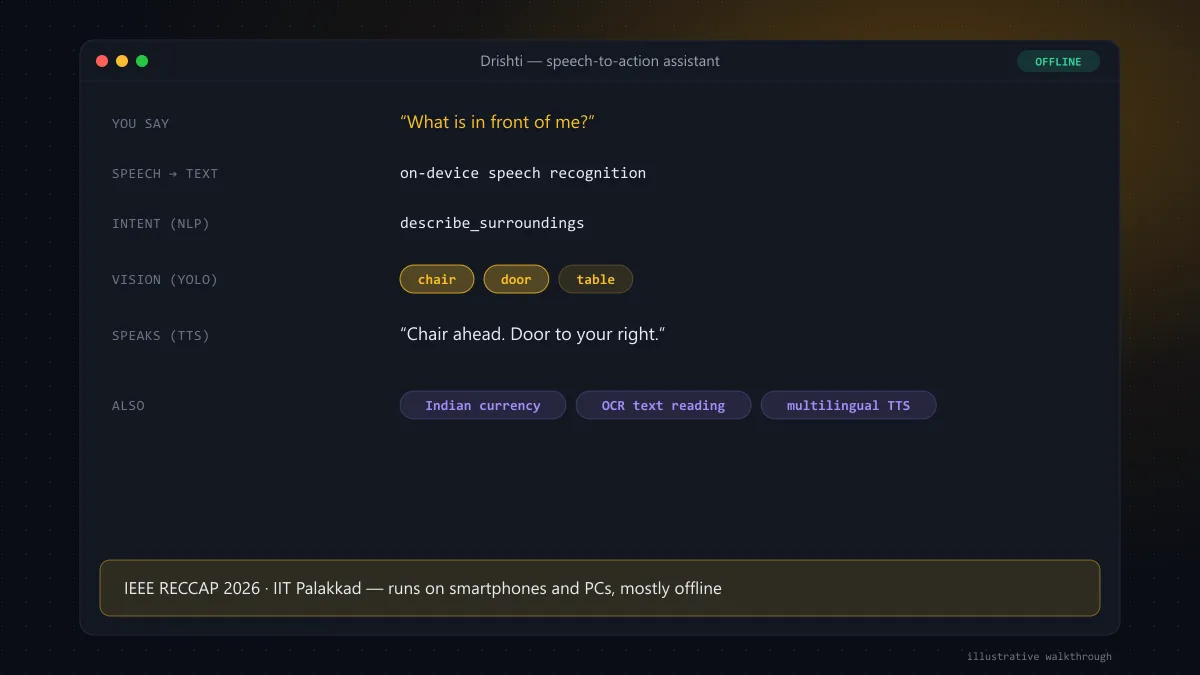
Drishti is a speech-to-action assistant for smartphones and PCs, which I co-authored and presented at IEEE RECCAP 2026. The user asks for something out loud and the assistant acts on it, then answers by voice.
- Speech recognition and NLP turn a spoken instruction into an intent.
- YOLO object detection describes what’s around the user.
- Indian currency classification identifies banknotes.
- OCR reads printed text aloud.
- Multilingual text-to-speech speaks every result back.
- Designed to work offline for most tasks.
Architecture
Spoken instruction → speech recognition → NLP intent → the matching module (object detection, currency classification or OCR) → text-to-speech response.
Results
The system was evaluated on household objects, Indian currency and printed text, and the paper reports high accuracy at low latency for the multimodal pipeline. Published in the proceedings of IEEE RECCAP 2026, IIT Palakkad (DOI 10.1109/RECCAP69368.2026.11723662).
Tech stack
- Speech & language: speech recognition, NLP intent handling, multilingual TTS
- Vision: YOLO object detection, currency classification, OCR
- Platforms: smartphones and PCs, mostly offline