
Problem
Indian social media often mixes Tamil and English in a single message — Romanised Tamil, Tamil script, hashtags, emoji, forwarded-message conventions and deliberate typos. Almost every fact-checking resource is monolingual, so claims written this way have no data to train or evaluate on.
What I built
CodeMixCheck — an openly released dataset for Tanglish claim verification, built for my final-year project at VIT with Dr. Sanjiban Sekhar Roy, and published on Hugging Face with a DOI.
- 7,254 released records of Tamil–English code-mixed, social-media-style text.
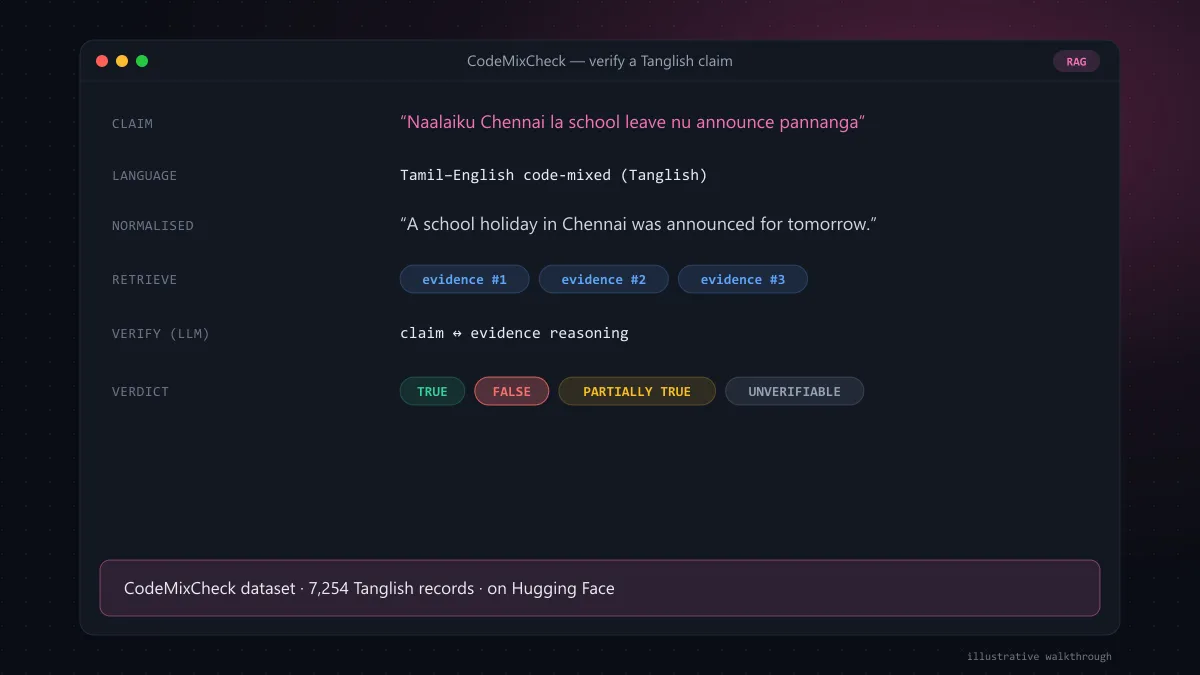
- A main 4-way veracity task —
True,False,Partially True,Unverifiable— with an optional 3-way mapping toSUPPORTED/REFUTED/NOT_ENOUGH_INFO. - Two auxiliary configurations, sentiment and abuse detection, for multi-task experiments.
- Roman, mixed and Tamil script, with controlled typing noise (none → heavy) kept as part of the signal.
- A separate hand-curated test set of 344 claims, labelled by me, to measure transfer from synthetic training data to natural claims.
Dataset design
- Two kinds of test data, never mixed:
test_syntheticmeasures in-distribution performance;test_curatedmeasures transfer to more natural claims. - Leak-aware splits: records are split at content-group and template-family level, and a release audit flags duplicates and cross-split overlaps row by row.
- Rich metadata: claim framing (forwarded message, official attribution, hearsay, report), script ratio, noise level, provenance and per-row version history.
- Reproducible statistics: the numbers in the dataset card are generated from the Parquet files, and a validation script fails if they drift.
Verification approach
The project studies retrieval-augmented, evidence-grounded veracity classification: instead of judging a claim from a model’s memory, relevant evidence is retrieved first and the claim is classified against it. The animation above is an illustrative walkthrough of that pipeline.
Responsible release
- Released under CC BY-NC 4.0 for non-commercial research.
- Most rows are synthetic and clearly documented as describing a simulated world — not real events.
- 341 human-collected social-media comments were held back, because their authors’ rights to redistribution weren’t mine to give, along with synthetic rows that closely resembled them.
- Known limitations, biases and out-of-scope uses are documented in the dataset card.
Tech stack
- Data: Python, pandas, Parquet, Hugging Face
datasets - NLP: code-mixed text processing, veracity classification, retrieval-augmented generation (RAG)
- Quality: duplicate and leakage audits, statistics and validation scripts